
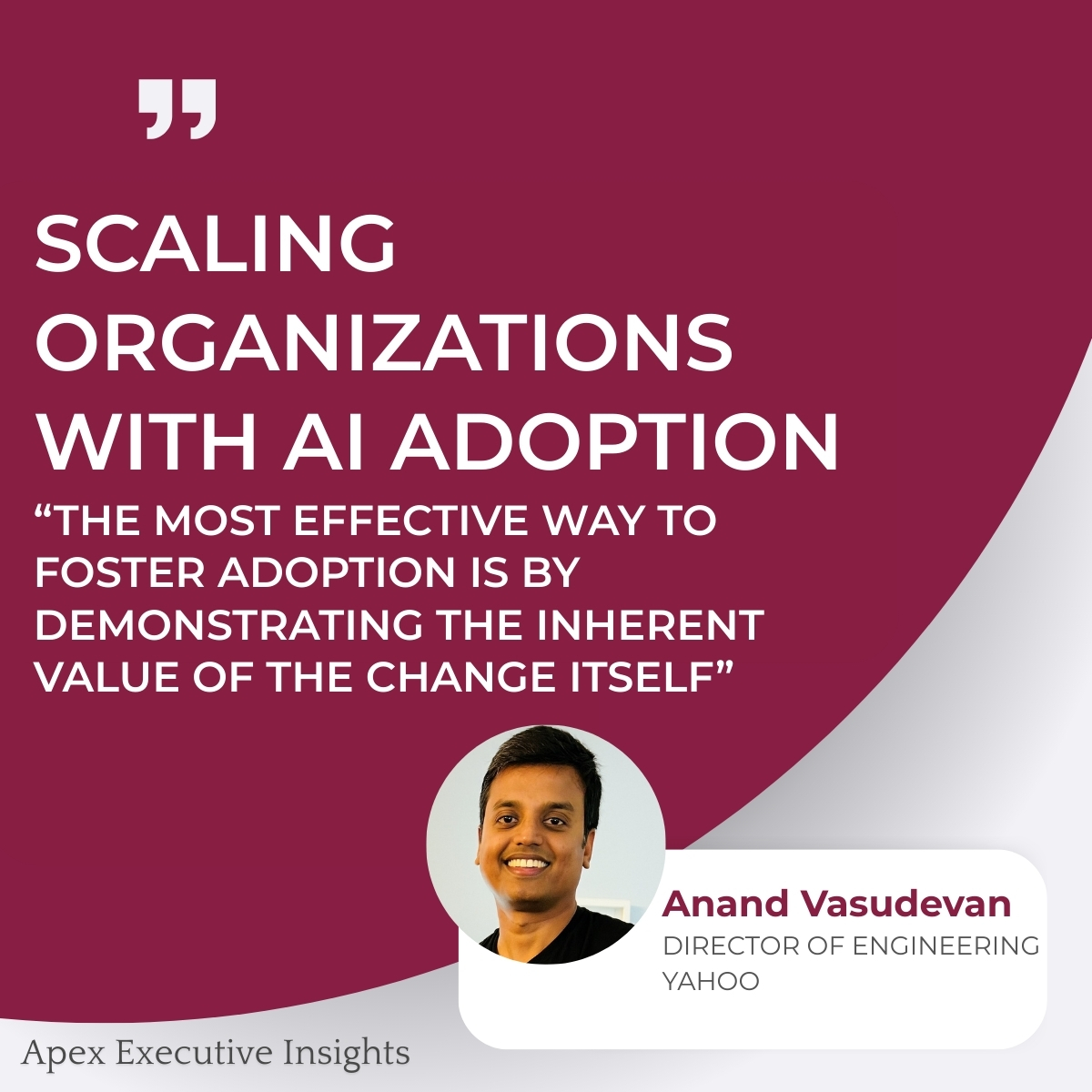
In this edition of Apex Executive Insights, we chat with Anand Vasudevan, Director of Engineering at Yahoo. Anand is a seasoned engineering leader with over 20 years of experience in building and scaling consumer products to millions of users. Currently, he leads globally distributed teams focused on AI-powered innovation and driving user and revenue growth in the Yahoo Mail product. Previously, he held leadership roles at Amazon, Motorola, and VC-backed startups, bringing deep expertise in scaling teams, driving growth, and launching new revenue streams. Anand is a graduate of the UC Berkeley Engineering Leadership program, a member of the advisory board for the University of San Francisco’s School of Management, and an active contributor to multiple leadership forums and the IEEE community, where he served as program chair for the recently concluded IEEE Enterprise GenAI Summit. Today, Anand will discuss his perspectives on scaling organizations with AI adoption.
Q: AI technology is evolving rapidly. How do you stay current with new tools and trends in the industry?
A: Having experienced firsthand numerous tech evolutions like the internet, wireless, mobile apps, and cloud migrations over two decades, I can say that AI’s pace is truly unprecedented. It’s tough to stay current with such rapid changes in AI models and
tools, and the frequent updates can sometimes be overwhelming. My stance is to stay open to exploring various options rather than oversimplifying or favoring a specific tool. The best way to learn in this fast-paced environment is through collective knowledge—so I actively network with industry leaders and peers in private forums and summits to learn from their experiences and apply those insights to my own challenges.
—
Q: What’s your approach to adopting AI in your organization?
A: My approach begins with acknowledging AI’s undeniable impact on our daily work. As a leader, it’s crucial to address any team member’s anxieties about AI replacing their roles, ensuring their psychological safety first. Beyond that, I champion three key practices for leaders within my organization:
● Build Prototypes: The best way to understand new technology is by engaging with it directly. I encourage every leader, regardless of their level or discipline, to conceive an idea (even if unrelated to their current product) and develop a working prototype using AI tools across different phases—validation, design, and even “vibe coding.” This fosters curiosity and equips them to ask more insightful questions when encountering challenges.
● Empower AI Champions: Leaders should identify early adopters and “AI champions” within their teams. By highlighting their efforts and providing incentives, their learnings can be leveraged across the organization, inspiring
others to experiment with AI.
● Support Failures: While business leaders naturally aim for immediate ROI from new technologies like AI, expecting short-term returns can stifle crucial experimentation. Though tracking metrics is important, it’s advisable to take a long-term view (12-18 months) on AI adoption to allow for productive failures and ultimately realize its full potential.
—
Q: What’s your leadership philosophy when it comes to driving this change?
A: I strongly resonate with Peter Senge’s quote: “People don’t resist change. They resist being changed.” Therefore, the most effective way to foster adoption is by demonstrating the inherent value of the change itself. As a leader, beyond showcasing impressive demos and working prototypes, it’s essential to establish a structured environment for sharing learnings and a dedicated forum for addressing pain points encountered during adoption. For example, regular workshops with a rotating team can provide dedicated time among their busy schedules to try and share their bottlenecks. AI champions could help to navigate those meetings and share reports on adoption by measuring the artifacts created by AI tools.
—
Q: What advice would you give someone entering the industry in this AI era?
A: Simply put: stay curious. While many discussions focus on AI replacing jobs, I believe this era will actually create more interesting positions and roles. By staying abreast of current trends and identifying existing gaps, you’ll be well-positioned to contribute unique value. Your sense of accomplishment, or “dopamine hit,” might just come from an entirely new place!
—
Final Thought
I appreciate your time in listening to this interview, and I sincerely thank Nicolette for the opportunity to share my views. I also look forward to hearing from the audience about how differently they would have approached this problem.
ROLE DESCRIPTION
We are looking for a Business Development Manager to join the company and take on one of the most opportunistic roles the industry has to offer. This is a role that allows for you to create and develop relationships with leading solution providers in the enterprise technology space. Through extensive research and conversation you will learn the goals and priorities of IT & IT Security Executives and collaborate with companies that have the solutions they are looking for. This role requires professionalism, drive, desire to learn, enthusiasm, energy and positivity.
Role Requirements:
Role Responsibilities
Apex offers our team:
Entry level salary with competitive Commission & Bonus opportunities
Apex offers the ability to make a strong impact on our products and growing portfolio.
Three months of hands on training and commitment to teach you the industry and develop invaluable sales and relationship skills.
Opportunity to grow into leadership role and build a team
Extra vacation day for your birthday when it falls on a weekday
All major American holidays off
10 paid vacation days after training period
5 paid sick days
Apply Now >>