
Apex Executive Insights
From Chaos to Clarity: Governing High-Stakes Portfolios at Scale
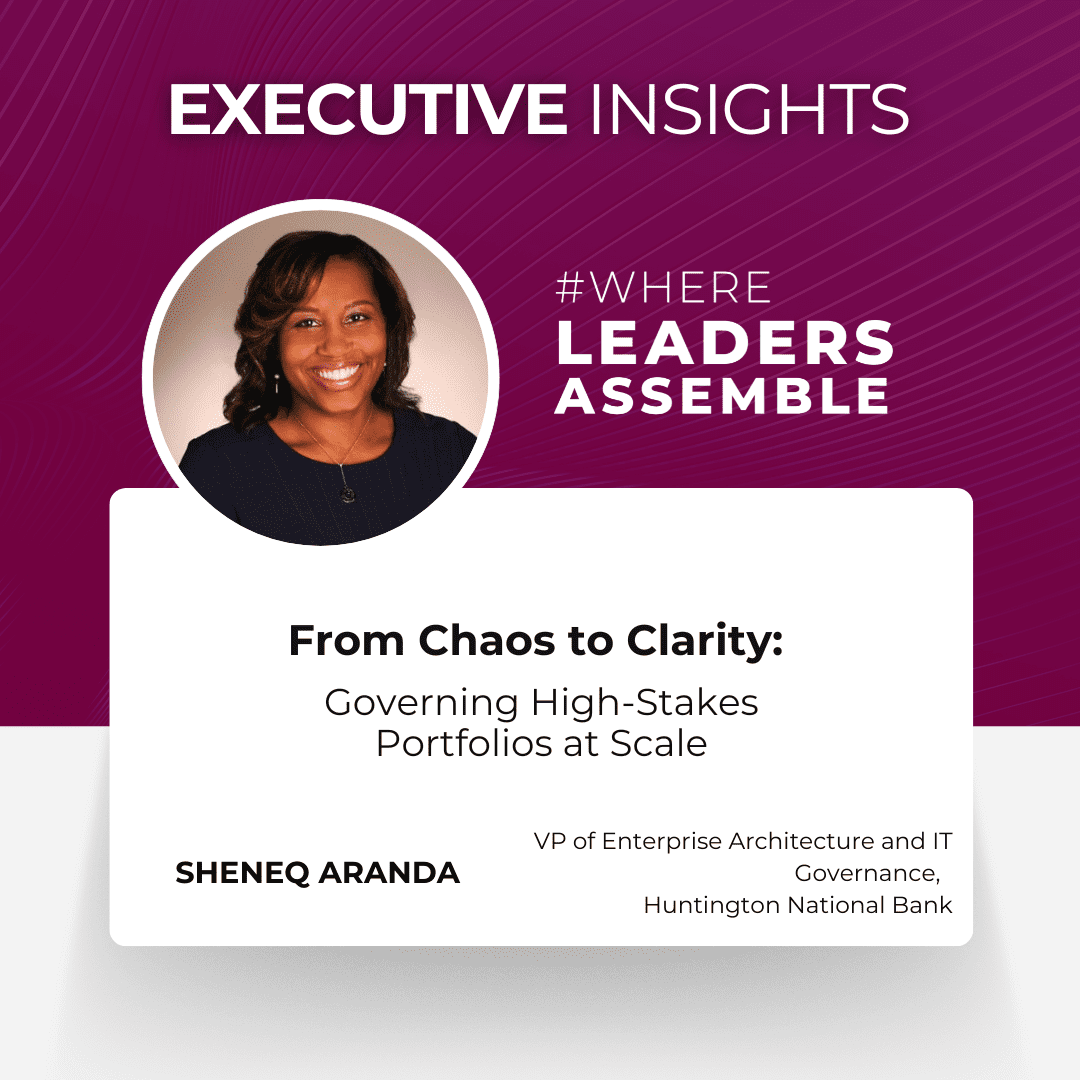
An Apex 1:1 with Sheneq Aranda, Vice President of Enterprise Architecture and IT Governance
Apex chats with Sheneq Aranda, a Vice President of Vice President of Enterprise Architecture and IT Governance with 15+ years of experience leading complex, cross-functional initiatives across financial services, energy, and technology. Known for bringing structure and momentum to high-stakes environments where priorities compete and ownership is distributed, Sheneq has scaled enterprise BPO and automation capabilities delivering ~$30M in savings, built portfolio governance across global organizations, and partnered with CIOs and executive teams to turn ambiguous mandates into durable operating models. In today’s Apex 1:1, Sheneq shares her philosophy on turning enterprise chaos into clarity and what it takes to lead without losing speed.
Q: You’ve spent your career in environments where complexity is the default-financial services, energy, global operations. What draws you to that kind of work?
A: Honestly, I’ve always been most energized when the path forward isn’t obvious, but I’m empowered to do something about it. Early in my career, working across Shell in Singapore, Deutsche Bank in London, and later Chevron and now Huntington, I noticed that the organizations that struggled most weren’t short on talent or resources. They were short on clarity: about what mattered, who owned what, and how to move. That gap between strategy and execution became the space I wanted to operate in. I find real satisfaction in being the person who helps a team see the signal through the noise and build something that actually holds.
Q: What does “chaos to clarity” actually mean in practice? Is it a methodology, a mindset, or something else?
A: Both and neither, fully. It starts as a mindset: you have to resist the urge to act before you understand. When you enter a complex initiative, the instinct is to start moving. But the most valuable thing you can do in the first 30–60 days is listen, map the terrain, and identify where the real friction is. From there, it becomes methodology: establishing governance that creates accountability without bureaucracy, building operating cadences that keep teams aligned without slowing them down, and designing decision frameworks that help leaders prioritize without second-guessing each other. The goal is always a durable operating model, not a project that ends, but a structure that continues to perform after the initial momentum and excitement fades.
Q: You scaled an enterprise BPO capability from infancy inside a $53B regulated institution and delivered ~$30M in savings. What did that actually require that isn’t obvious from the outside?
A: The easy answer is governance, process design, and vendor management, and marketing. But the harder answer is trust. In a regulated environment, no one will hand over operational processes to an external provider unless they believe the oversight model is sound and the people running it have sound judgment. I spent significant time building credibility with the CIO, the CRO, and 10 lines of business before we could move with real speed. I also had to design intake and prioritization processes that felt fair, because if business units don’t believe their work will be handled correctly by, they’ll work around the model instead of into it. The savings came from the execution, but the execution was only possible because of the trust architecture we built first.
Q: You’ve led in highly matrixed environments without formal authority over many of the stakeholders you needed to move. How do you think about influence at that level?
A: I think about it as earning the right to be in the room and then using that position to create alignment rather than advocacy. When you don’t have a direct reporting line, you can’t rely on positional authority. What you can rely on is being prepared, being transparent about trade-offs, and making it easier for leaders to say yes than to say no. I’ve found that the executives who are hardest to move are usually the ones who haven’t been given a clear picture of what’s at stake or what’s being asked of them. When you do that work upfront, anticipating their concerns, framing the ask in their language, connecting it to outcomes they care about, alignment follows much more naturally.
Q: AI and automation are reshaping enterprise operations. From your vantage point, what are organizations getting wrong about this moment?
A: They’re treating AI adoption as a technology initiative when it’s actually an operating model transformation. The technology is increasingly accessible. What’s hard is the governance: deciding what to automate, ensuring the right controls are in place, managing the human side of displacement and reskilling, and building the metrics to know whether it’s actually delivering value. I saw this pattern with BPO and RPA, and I’m seeing it again with AI. The organizations that get the most value are the ones that slow down enough to design the operating model before they scale the technology, not after.
Q: What advice would you give to a mid-level leader who wants to operate at the enterprise level but isn’t there yet?
A: Get comfortable with ambiguity and then learn how to reduce it for others. The shift from functional leader to enterprise leader isn’t just scope; it’s a different relationship with uncertainty. At the enterprise level, the problems are rarely well-defined, the ownership is rarely clean, and the answers are rarely obvious. What distinguishes the leaders who thrive is their ability to bring structure to ambiguous situations without waiting for someone else to do it first. I’d also say: build relationships before you need them. The executives I’ve seen advance most consistently are the ones who’ve invested in cross-functional relationships long before they needed to call on them.
“Clarity isn’t the absence of complexity. It’s the discipline to understand it well enough to act. That’s the work I show up to do every day.”
About the Author
Sheneq Aranda is a Vice President of Enterprise Architecture and IT Governance specializing in enterprise transformation, portfolio governance, and global business services. With 15+ years of experience across financial services, energy, and technology, she has scaled BPO and automation capabilities delivering ~$30M in savings, built governance frameworks across 10+ lines of business, and partnered with CIOs and executive teams to translate strategy into durable operating models. She has held leadership roles at Huntington National Bank, Chevron, Deutsche Bank, and AIG, and serves on the boards of Multiplier and the Upper Kirby Foundation – Levy Park Conservancy.
ROLE DESCRIPTION
We are looking for a Business Development Manager to join the company and take on one of the most opportunistic roles the industry has to offer. This is a role that allows for you to create and develop relationships with leading solution providers in the enterprise technology space. Through extensive research and conversation you will learn the goals and priorities of IT & IT Security Executives and collaborate with companies that have the solutions they are looking for. This role requires professionalism, drive, desire to learn, enthusiasm, energy and positivity.
Role Requirements:
Role Responsibilities
Apex offers our team:
Entry level salary with competitive Commission & Bonus opportunities
Apex offers the ability to make a strong impact on our products and growing portfolio.
Three months of hands on training and commitment to teach you the industry and develop invaluable sales and relationship skills.
Opportunity to grow into leadership role and build a team
Extra vacation day for your birthday when it falls on a weekday
All major American holidays off
10 paid vacation days after training period
5 paid sick days
Apply Now >>