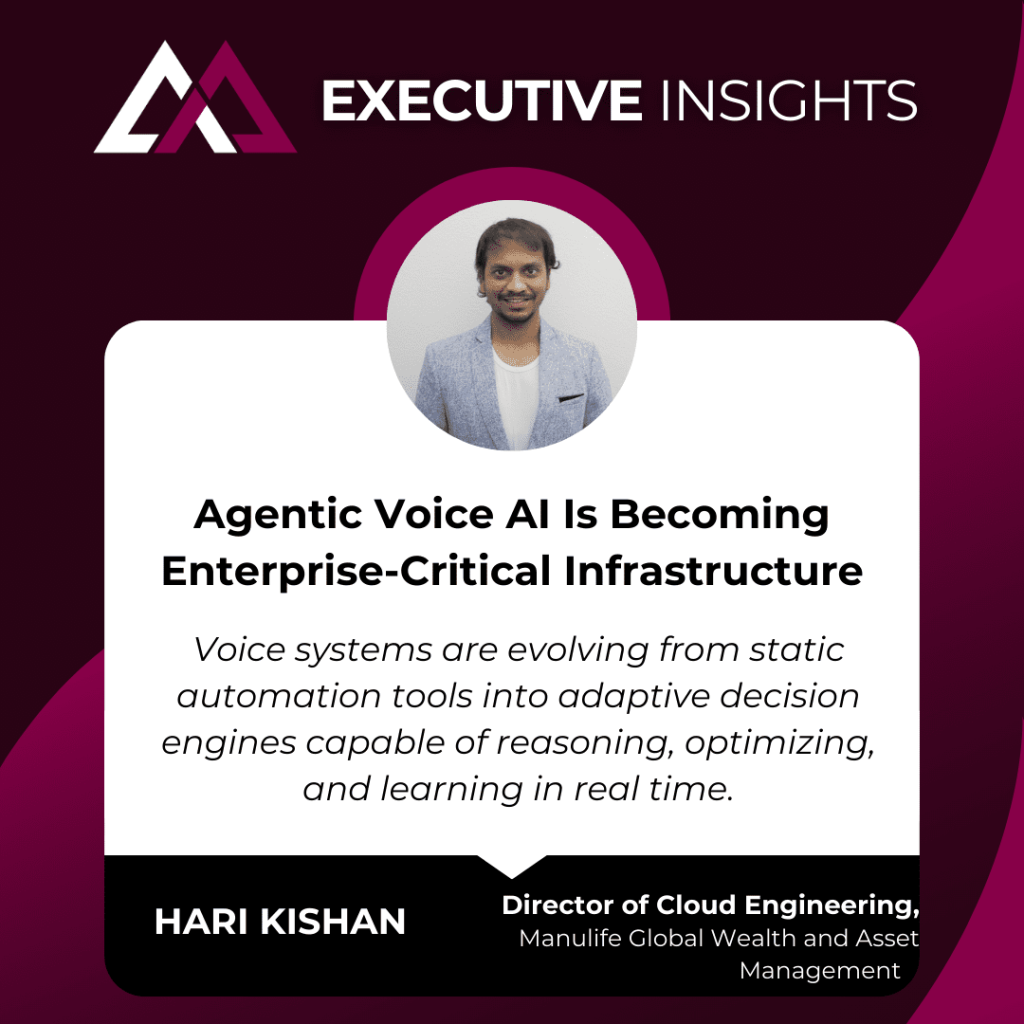
Agentic Voice AI Is Becoming Enterprise-Critical Infrastructure
By Hari Kishan, Director of Cloud Engineering, Manulife Global Wealth and Asset Management
You are recognized for advancing enterprise Voice AI architectures. What distinguishes your work from conventional implementations?
Traditional IVR and chatbot systems rely on deterministic logic and static intent routing. My work has focused on engineering production grade agentic voice systems capable of contextual reasoning, real-time decision optimization and closed loop performance learning.
In regulated industries such as insurance and healthcare, these systems must operate under strict compliance frameworks(HIPAA, PCI-DSS, GDPR etc) while maintaining sub second latency and measurable business KPIs.
The contribution is not incremental automation. It is the architectural transition from scripted telephony trees to intelligent orchestration frameworks that continuously adapt based on behavioral data, performance telemetry, and customer context.
What original contributions have you made to the field of conversational AI?
My primary contribution lies in designing and operationalizing:
- Memory-aware conversational orchestration layers
- KPI-optimized routing architectures
- Guardrail-driven LLM deployment models
- Closed-loop feedback systems integrating analytics and AI retraining
- Customizing Frontier Models for Insurance use cases
These frameworks move Voice AI from experimental deployment to enterprise-critical infrastructure.
The measurable impact includes multi-million-dollar operational efficiencies, improved first-call resolution, fraud-risk mitigation, and increased customer satisfaction metrics across high-volume call ecosystems.
The broader significance is the establishment of repeatable architectural patterns now being adopted across large-scale customer experience platforms.
Why is production-grade Voice AI considered a complex systems engineering challenge?
Unlike text-based AI interfaces, enterprise voice systems operate in real-time environments where:
- Identity verification and fraud detection must occur mid-conversation
- Regulatory compliance must be enforced dynamically
- Routing decisions impact operational cost structures
- Sentiment and escalation logic influence customer retention.
This requires the integration of telephony platforms, NLU engines, large language models, CRM systems, analytics pipelines, and observability frameworks.
Engineering such systems at enterprise scale requires cross-domain expertise in distributed systems, AI governance, cloud architecture, and performance optimization.
How does your work demonstrate major significance within the industry?
In high-volume enterprise call centers, even marginal efficiency gains (3–5%) can represent millions in annual cost impact.
The systems I have led and architected have:
- Reduced unnecessary human escalations
- Improved self-service containment
- Enhanced fraud detection orchestration
- Increased measurable CX KPIs
Beyond financial metrics, the significance lies in creating scalable AI governance models that allow regulated enterprises to safely deploy advanced generative capabilities.
These architectural approaches are influencing how large organizations conceptualize next-generation conversational platforms.
In addition to your engineering leadership, you serve as a peer reviewer, public speaker, and author. How do these roles reinforce your contributions to the field?
Beyond building enterprise systems, I believe it’s important to contribute back to the broader AI community.
As a peer reviewer for international journals, I evaluate research submissions and provide feedback on technical depth, originality, and real-world applicability. It’s a responsibility I take seriously, because it means helping shape the quality and direction of work entering the field.
As a public speaker, I share lessons learned from deploying conversational AI in highly regulated, large-scale environments. These talks aren’t theoretical; they come from real production challenges, including governance, compliance, and measurable business outcomes. Engaging with practitioners across industries keeps the conversation grounded in practical impact.
I’m also authoring a book focused on Agentic Conversational AI and enterprise voice systems. The goal is to document architectural patterns, common pitfalls, and scalable frameworks that others can apply in their own organizations. Writing long form allows me to consolidate years of hands-on experience into something structured and useful for the next generation of builders.
Together, these roles extend my work beyond a single organization. They reflect ongoing engagement with the field not just implementing systems, but contributing to how enterprise AI is understood, discussed, and responsibly deployed.
How do you define leadership in enterprise AI transformation?
Leadership in this domain is not limited to model selection. It involves:
- Establishing governance frameworks
- Designing scalable AI infrastructure
- Aligning technology decisions with business KPIs
- Mentoring cross-functional engineering teams
- Driving modernization of legacy telephony ecosystems
The transition from legacy IVR to agentic voice systems represents a structural shift in enterprise architecture strategy.
Leading such transformation requires both technical depth and strategic execution capability.
What is the future trajectory of Agentic Voice AI?
The field is moving toward:
- Persistent conversational memory architectures
- KPI-aware autonomous routing systems
- Context-lake driven personalization
- Real-time compliance enforcement layers
- Self-optimizing orchestration frameworks
Voice systems will increasingly function as adaptive decision engines rather than static automation tools.
The next generation of enterprise AI will not merely respond, it will reason, adapt, and continuously optimize performance outcomes.
About Hari Kishan, Director of Cloud Engineering, Manulife Global Wealth and Asset Management
Venkata Harikishan Koppuravuri (often referred as Hari Kishan) is a Director of Cloud Engineering and enterprise conversational AI leader driving large scale AI modernization initiatives in regulated industries. He leads the transformation of legacy IVR systems into intelligent, agentic voice platforms that combine governance, real-time analytics, and measurable operational impact.
He also serves as a peer reviewer for international AI journals, a public speaker on enterprise AI strategy, goveranc, and is authoring a book on Agentic Conversational AI. He has multiple publications on Agentic AI, Frontier and Voice AI models, his work reflects sustained leadership at the intersection of advanced AI systems and enterprise transformation.
LinkedIn: https://www.linkedin.com/in/hari-kishan/

ROLE DESCRIPTION
We are looking for a Business Development Manager to join the company and take on one of the most opportunistic roles the industry has to offer. This is a role that allows for you to create and develop relationships with leading solution providers in the enterprise technology space. Through extensive research and conversation you will learn the goals and priorities of IT & IT Security Executives and collaborate with companies that have the solutions they are looking for. This role requires professionalism, drive, desire to learn, enthusiasm, energy and positivity.
Role Requirements:
Role Responsibilities
Apex offers our team:
Entry level salary with competitive Commission & Bonus opportunities
Apex offers the ability to make a strong impact on our products and growing portfolio.
Three months of hands on training and commitment to teach you the industry and develop invaluable sales and relationship skills.
Opportunity to grow into leadership role and build a team
Extra vacation day for your birthday when it falls on a weekday
All major American holidays off
10 paid vacation days after training period
5 paid sick days
Apply Now >>