AI as an Elevation of Engineering with Sivakumar Kumaravelu
Apex Executive Insights

AI as an Elevation of Engineering with Sivakumar Kumaravelu
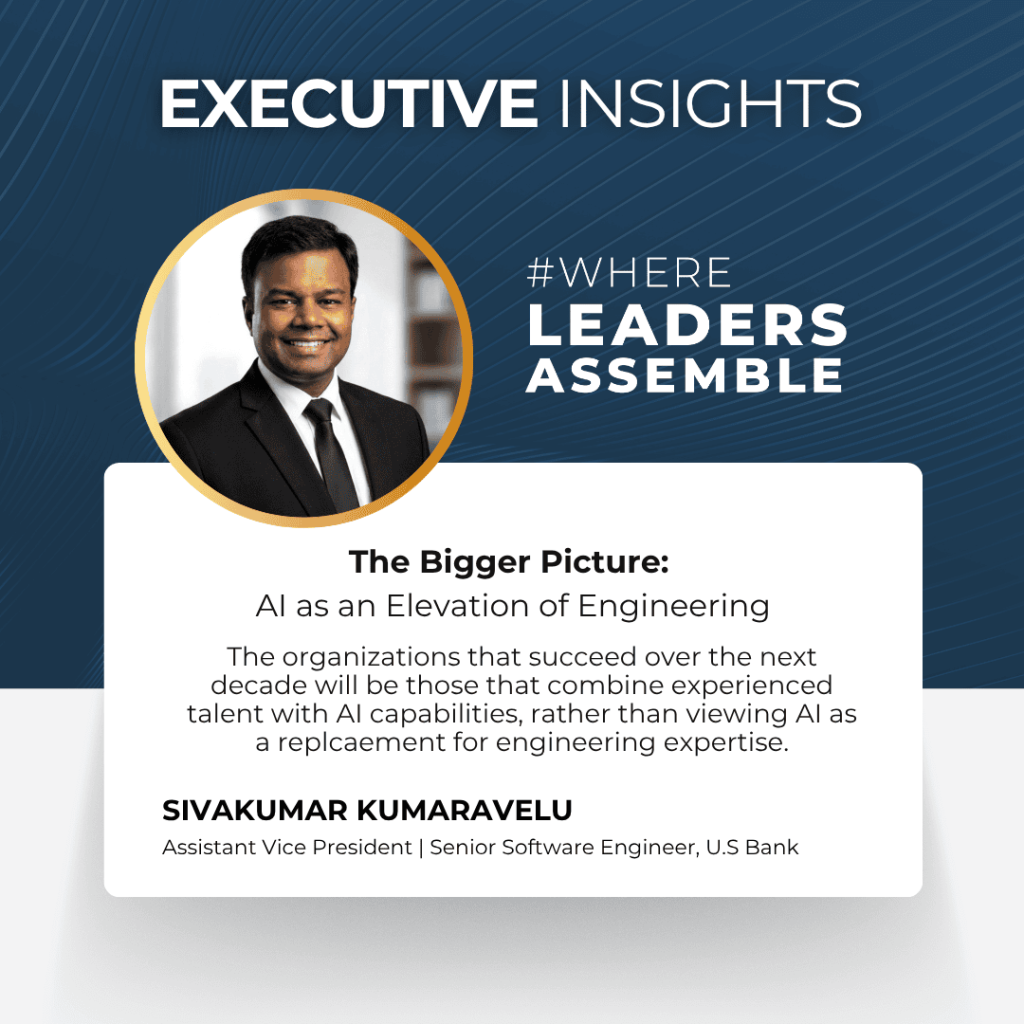
An Apex 1:1 with Sivakumar Kumaravelu, Assistant Vice President | Senior Software Engineer, U.S Bank

How do you see AI transforming the business landscape in the next 5-10 years, and how is your organization preparing for these changes?

Having spent over 20 years in IT, with the last 4 years specifically in payment modernization at U.S. Bank, I see AI triggering a fundamental shift in the next decade—moving us from reactive systems to predictive and autonomous systems. AI is transforming the landscape in two distinct waves over the next decade.

The first wave—which we are in right now—is developer productivity. The second wave—which will define the next 5-10 years—is intelligent business operations, where AI moves from helping us build software to actually running parts of the payment lifecycle.

But the way we are preparing at U.S. Bank is uniquely pragmatic, because we balance innovation with the extreme regulatory scrutiny that comes with handling critical customer financial data.

Let me break down how I see this transformation happening, and how we are preparing, based on what my teams are doing right now:

  1. The Developer Productivity Layer (The Present):
    We are already deep in this transformation. We are using Microsoft Copilotextensively for code generation, which has significantly accelerated our development velocity. But we aren’t stopping there—we are actively moving toward spec-driven development. In the next few years, I see our architects and senior engineers spending less time writing boilerplate integration code and more time writing high-level business specifications. The AI, through Copilot and our custom tooling, will generate the underlying microservices scaffolding. For a 20-year IT veteran like me, this is a massive shift—we are evolving from ‘coders’ to ‘system designers.’
  2. The Architectural Reality (Modernization + AI):
    My team has been modernizing our monolithic payment applications into microservices deployed on Azure. This modernization isn’t just for scalability; it’s the prerequisitefor AI. You cannot apply intelligent routing or predictive fraud detection to a monolith. By breaking these services down and moving to Azure, we are creating the clean, observable data pipelines that our future AI models will depend on. Over the next 5 years, AI will sit on top of these Azure-deployed microservices to dynamically route transactions for optimal speed and cost—but only because we did the hard work of modernization first.
  3. The ‘Intelligent Tooling’ Layer (Our Internal Innovation):
    This is where we are actually ahead of the curve. We built an internal workflow tool, which directly calls other tools—JIRA, Git, and Confluence—via APIs before making any LLM calls. Instead of blindly feeding massive context into a model and wasting tokens (and risking inaccuracies), we retrieve the exactrelevant ticket details, code history, or documentation first, and then pass that curated data to the LLM. This approach reduces token usage, lowers latency, and gives us far more reliable outputs. In the next 5 years, this ‘tool-calling’ architecture will become the standard for enterprise AI. We aren’t just using AI; we are engineering how it interfaces with our ecosystem.
  4. The Skeptical, Risk-Aware Layer (Crucial for Banking):
    This is the most important part, given our industry. Unlike consumer tech companies, we are very restrained and skepticalabout using MCP (Model Context Protocol) and RAG (Retrieval-Augmented Generation) broadly. Because we handle critical customer financial information, we cannot afford data leakage or hallucinations. For testing automation we have an MCP approved, any other MCP faces significant scrutiny before we bring it in. We are preparing for the next 10 years by building strict guardrails. We are investing heavily in private, secure Azure environments where our data never leaves our control. We are moving forward, but we are doing it with our eyes wide open—prioritizing explainability and auditability over speed.

In 10 years, the business landscape will be defined by AI agents interacting with each other—a procurement agent negotiating with a bank’s payment agent. U.S. Bank is preparing for this not by rushing blindly, but by modernizing our microservices on Azure, enhancing developer workflows with Copilot and spec-driven development, and innovating through internal workflow tools—all while maintaining a healthy skepticism around RAG and MCP to protect our customers.

My experience has taught me that infrastructure wins in the long run. And right now, we are building that infrastructure the right way.

Q: What are the biggest challenges your company has faced when implementing AI technologies, and how did you overcome them?

A: I’ve seen technology shifts come and go—but AI is different. It’s moving faster than anything I’ve experienced, and in a regulated industry like banking, that speed creates unique friction. I’d break down the challenges we’ve faced into four core areas, and how we’ve tackled them.

Challenge 1: Adoption and Cultural Resistance

The first hurdle wasn’t technical—it was human. When we rolled out AI-powered code generation tools, adoption was surprisingly slow. Many senior engineers, myself included initially, were skeptical. We’d spent decades honing our craft, and suddenly a tool was generating code that looked right but required intense scrutiny. The resistance wasn’t stubbornness; it was a healthy fear of introducing bugs or security flaws into payment systems where millions of dollars flow daily.

How we overcame it: We realized that adoption required demonstration, not mandate. Our AI Center of Excellence ran intensive boot camps and brought in vendor experts to do live, real-world demos using our actual codebase. Seeing a complex microservice integration generated in seconds, with clean error handling, flipped the narrative. We focused heavily on custom instructions and teaching teams the fundamentals of tool calling and functions—not as abstract concepts, but as practical skills they could apply immediately. We also shifted toward spec-driven development, which helped engineers see AI not as a threat, but as a junior pair programmer that handles boilerplate while they focus on architecture, security, and business logic. Once people experienced the productivity gain firsthand, adoption accelerated organically.

Challenge 2: The Knowledge Gap and the Relentless Pace of Change

Just when we felt comfortable with code generation, the landscape shifted. Within months, we were hearing about MCP, RAG, Agentic AI, and autonomous workflows. It felt like trying to drink from a firehose. The knowledge gap wasn’t just about learning new terms; it was about understanding how to apply these concepts safely in a banking context. Frankly, coping with this pace is still a challenge—the space evolves so fast that what we learned six months ago is already outdated.

How we overcame it: We invested heavily in continuous learning, not one-off training. We built an internal culture where engineers share wins and failures openly. We created practical, hands-on workshops that moved beyond theory—for example, we built an internal tool that directly calls our JIRA, Git, and Confluence APIs before making any LLM calls. This approach, which I personally worked on, taught our teams the value of curated data retrieval: reduce token usage, lower latency, and get more accurate outputs. It also forced us to understand the mechanics of tool calling, which is now a foundational skill for anyone working with AI. We didn’t wait for formal training programs; we learned by building, failing, and iterating. That mindset has been critical to keeping pace.

Challenge 3: Privacy, Data Sovereignty, and Regulatory Scrutiny

This is the elephant in the room. Unlike a tech startup, we can’t just experiment with customer data. We are very restrained and skeptical about using MCP and RAG broadly because we handle critical financial information. A hallucinated code suggestion is one thing; a hallucinated transaction decision is catastrophic. Additionally, regulators are paying close attention. AI governance is now a standing item in examinations, with questions about model explainability, vendor risk, and ‘kill switches’ for malfunctioning systems.

How we overcame it: We embedded risk and compliance into the process from Day 1, rather than treating them as a final gatekeeper. This collaborative approach actually accelerated approvals because we addressed concerns early, not at the last minute. We also made a firm architectural decision: we only use AI in secure, private cloud environments where data never leaves our control. We never feed PII or actual payment details into LLM calls—the AI works on transformed or synthetic data. We also implemented strict role-based access controls so that any AI tool, including our internal ones, only retrieves information the user is already authorized to see. It’s an ongoing effort, and our Risk teams are helping us navigate these open issues, but we’ve built a governance framework that balances innovation with safety.

Challenge 4: The Strategic Dilemma—Innovate vs. Stabilize

There’s a public debate in our industry about whether banks should be AI leaders or fast followers. We’ve chosen a pragmatic middle path. The challenge is that you can’t pause innovation while you perfect governance, but you also can’t rush into production without confidence. We’ve seen other institutions make headlines with AI rollouts, but the question we constantly ask is: Is this production-ready for a bank?

How we overcame it: We started small and controlled. For example, we approved Playwright MCP for test automation because it’s low-risk—it generates test scripts, not transaction logic. This gave us a safe sandbox to learn the technology, build our internal review processes, and gain confidence. We then systematically applied those lessons to more complex use cases. We also focused on foundational work—modernizing our monolithic payment applications into microservices deployed on Azure, and building robust data pipelines. Why? Because AI is only as good as the data and infrastructure it sits on. By doing the hard work of modernization first, we’re now positioned to adopt new AI capabilities faster and safer than if we had rushed ahead.

The biggest challenges have been cultural resistance, the relentless pace of change, data privacy, and the strategic tension between innovation and stability. We overcame them by prioritizing hands-on training, embedding risk early, starting with low-risk use cases, and focusing on infrastructure fundamentals. It’s not a solved problem—the privacy concerns are still open, and the pace of change shows no signs of slowing. But we’ve built the right muscle memory. With 20+ years of experience, I’ve learned that success isn’t about avoiding challenges; it’s about having the right process, governance, and team culture to navigate them safely. And at U.S. Bank, we’re doing exactly that.

Q: How does your organization address ethical concerns surrounding AI, such as bias, transparency, and accountability?

A: I’ve seen how ethical concerns around AI aren’t just theoretical—they are operational realities that can impact millions of customers and billions in transactions. In banking, bias in a credit decision, opacity in a fraud alert, or lack of accountability in a transaction routing error can have serious regulatory and reputational consequences.

Our organization addresses these concerns through a three-pillar approach: proactive bias detection, built-in transparency, and human-centered accountability. Let me walk you through each from my perspective.

Pillar 1: Bias Detection and Fairness

The most immediate ethical concern is bias. In payments, bias could manifest as an AI model that disproportionately flags transactions from certain demographics as fraudulent, or routes payments from specific regions with higher fees. We address this in two ways:

First, we audit our training data rigorously. When we modernized our monolithic payment applications into microservices on Azure, we didn’t just move code—we cleaned and cataloged data. We ensure that the historical transaction data we feed into models is representative and that we explicitly test for disparate impact across customer segments.

Second, we use synthetic or transformed data for AI training rather than raw PII. This minimizes the risk of encoding demographic bias because the model never sees sensitive attributes like race, gender, or age. We also conduct regular ‘fairness checks’ where our risk and compliance teams run adversarial tests—trying to ‘trick’ the model into making a biased decision. If a model fails, it doesn’t go to production. It’s a non-negotiable gate.

Pillar 2: Transparency and Explainability

Transparency is particularly challenging with AI because you’re dealing with probabilistic outputs, not deterministic rules. But for a bank, customers and regulators demand to know why a decision was made—whether it’s declining a payment, flagging fraud, or routing a transaction.

To address this, we prioritize explainable AI architectures. We are very restrained about using black-box models for high-stakes decisions. Instead, we use techniques like feature attribution, which tells us exactly which input variables (e.g., transaction amount, merchant category, location) influenced the output. If a payment is flagged, our system can generate a human-readable rationale: “This transaction was flagged because the amount is 300% above the customer’s average and the merchant is in a high-risk category.”

We also log every AI interaction—the input prompt, the context retrieved, and the final output. This creates an auditable trail. In payment modernization, this is critical because if a transaction goes wrong, we can trace back exactly what data the AI saw and how it arrived at its recommendation. This isn’t just good engineering; it’s how we pass regulatory exams. Regulators now routinely ask about AI models, and having that traceability is non-negotiable.

Pillar 3: Accountability and Human Oversight

This is where our banking DNA shows up. We have a foundational principle: AI augments, but humans decide. For high-value payment decisions, the AI can generate a recommendation, but a trained human—often a senior engineer or a fraud analyst—reviews and signs off before action is taken. This isn’t about distrusting the technology; it’s about recognizing that AI is probabilistic, and payments are deterministic. A 99.9% accuracy rate still means 1 in 1,000 transactions could be wrong.

To enforce accountability, we have clear ownership of each AI model. Every model has a designated business owner, a technical owner, and a risk owner. These aren’t abstract roles; they are specific individuals who are accountable for the model’s performance, monitoring, and retirement. We also run continuous monitoring—if a model’s performance drifts (say, fraud detection accuracy drops), alerts are triggered, and the model is automatically pulled from production until it’s remediated.

Additionally, we’ve embedded risk partners into our development teams from Day 1. This is the biggest shift I’ve seen in my 20-year career: compliance isn’t a final gate that slows things down; it’s a collaborative partner that helps us design ethical systems from the ground up. This collaborative approach has actually accelerated our approvals because we address concerns early, not at the last minute.

In summary: We address AI ethics through rigorous bias testing, built-in transparency with auditable trails, and unwavering human accountability. We’ve learned that ethics isn’t a one-time checkbox; it’s a continuous discipline. By embedding risk partners early, prioritizing explainable models, and maintaining clear ownership for every AI decision, we balance innovation with responsibility. In my experience, I’ve seen that banks that treat ethics as a competitive advantage—not a compliance burden—are the ones that earn lasting customer trust. And that’s exactly what we’re building at U.S. Bank.

Q: What skills or roles do you believe are most critical for building a strong AI-driven team, and how do you attract and retain such talent?

A: I believe building a successful AI-driven organization is far more about people, processes, and governance than simply adopting the latest AI models. Large language models are becoming increasingly commoditized—the real competitive advantage comes from how effectively an organization integrates AI into its engineering and business workflows.

In my view, there are five critical roles and skill sets that form the foundation of a strong AI-driven team.

  1. Strong Software Engineers and Architects

AI can accelerate development, but you still need engineers who deeply understand system design, distributed systems, security, and scalability. Someone has to validate AI-generated code, design resilient architectures, and ensure solutions are maintainable over the long term. In payment modernization, where we handle billions in transactions, this foundational engineering excellence is non-negotiable.

  1. Domain Experts

In banking, understanding payments, fraud, compliance, and regulatory requirements is just as important as understanding AI. The quality of an AI solution depends heavily on the business context it is given. A model might generate technically correct code, but if it doesn’t understand the nuances of payment settlement or sanctions screening, it’s not production-ready.

  1. AI and Data Specialists

These engineers understand model selection, prompt engineering, evaluation, model lifecycle management, and the responsible use of technologies such as Retrieval-Augmented Generation. They also work with vector databases where appropriate. Their role is to ensure AI solutions are accurate, measurable, and continuously improving—not just one-off experiments.

  1. Platform Engineers

This role is becoming increasingly critical. Platform engineers build secure AI infrastructure, integrate enterprise systems with AI capabilities, expose internal tools through controlled interfaces, manage observability, optimize costs, and enforce governance. As organizations move toward AI-powered development platforms, this role will only grow in importance.

  1. Governance, Security, and Risk Professionals

This is especially essential in financial services. AI adoption must be balanced with data privacy, regulatory compliance, model validation, and responsible AI practices. Innovation without governance creates unnecessary and unacceptable risk. These professionals ensure we move forward safely.

Q: How We’ve Applied This at U.S. Bank

A: Within my organization, I’ve seen this balanced approach firsthand. We’ve adopted Microsoft Copilot to improve developer productivity, and we’re moving toward specification-driven development—where engineers spend more time defining business intent and validating AI-generated implementations rather than writing boilerplate code.

At the same time, we’ve taken a disciplined approach to enterprise AI. New capabilities such as MCP servers or Retrieval-Augmented Generation are evaluated carefully before adoption because protecting customer data and maintaining regulatory compliance are non-negotiable.

We’ve also invested in internal AI orchestration capabilities that connect engineering tools—such as source control, work management, and documentation systems—directly into controlled workflows. Rather than sending large amounts of enterprise data to an LLM, our platform retrieves only the relevant context needed for a specific task. This improves both efficiency and governance while reducing unnecessary token usage.

Attracting and Retaining AI Talent

When it comes to attracting and retaining AI talent, I don’t think compensation alone is enough. The best engineers want to solve meaningful problems, work with modern technologies, and continue learning. Organizations should create an environment where engineers can safely experiment with AI, contribute to architectural decisions, and see the business impact of their work.

Equally important is establishing clear governance so engineers can innovate with confidence, knowing there are secure guardrails in place. In banking, this is particularly important—engineers need to know they’re working in a safe, compliant environment where their innovations can actually reach production.

Investing in Upskilling

As an architect, I also believe it’s important to invest in upskilling existing engineers rather than assuming every AI capability requires hiring specialists. Strong software engineers already understand problem solving, distributed systems, and software quality. With the right training in AI concepts, prompt engineering, and responsible AI practices, they can become highly effective AI engineers.

I’ve seen this work in practice. Through our AI Center of Excellence and intensive boot camps, we’ve transformed skeptical senior engineers into enthusiastic AI practitioners. They bring decades of domain knowledge that no newly hired specialist could replicate.

The organizations that succeed over the next decade will be those that combine experienced engineering talent with AI capabilities, rather than viewing AI as a replacement for engineering expertise. We’re building that balance at U.S. Bank—investing in the right roles, upskilling our people, and maintaining the governance needed to innovate responsibly.

Q: What emerging trends in AI are you most excited about, and how do you see them shaping your industry or business operations?

A: There are several AI trends that I find particularly exciting because I believe they will fundamentally change how enterprise software is built and how businesses operate. These aren’t just incremental improvements—they represent a shift in the very nature of engineering and business operations.

Trend 1: Agentic AI

We’ve moved beyond using AI simply to generate text or code. The next evolution is AI systems that can reason, plan, and execute business workflows by interacting with enterprise applications. In banking, I can see AI coordinating activities such as payment investigations, operational support, fraud analysis, and customer servicing—orchestrating multiple systems while keeping humans involved for approval and oversight.

How this shapes our industry: Agentic AI will shift banking from a reactive model—where customers come to us when they need something—to a proactive model, where we anticipate and act on their behalf. For payment modernization, this means our microservices and APIs need to be designed not just for human users, but for AI agents. The potential to significantly improve operational efficiency is enormous.

Trend 2: Specification-Driven Development

As AI becomes more capable, I believe software engineering will increasingly shift from manually writing every line of code to defining clear business requirements, architecture, and constraints. AI will generate much of the implementation, tests, documentation, and deployment artifacts, while engineers focus on validating the output, making architectural decisions, and ensuring quality, security, and maintainability.

How this shapes our industry: In payment modernization, this means we can accelerate the migration of legacy monoliths to microservices. Instead of manually rewriting thousands of lines of transaction logic, our engineers can focus on defining the what—business rules, compliance requirements, performance SLAs—while AI helps with the how. I see this as one of the biggest shifts in software engineering over the next decade.

Trend 3: AI-Native Engineering Platforms

Rather than using isolated AI tools, organizations are building platforms that integrate AI directly into the software development lifecycle. These platforms connect source control, work management, documentation, testing, deployment pipelines, and enterprise knowledge—so developers receive relevant context within their normal workflow.

How this shapes our industry: This improves productivity while maintaining governance and reducing unnecessary interactions with large language models. Within my organization, we’ve already invested in internal orchestration capabilities that retrieve only the relevant context needed for a specific task, rather than sending large amounts of enterprise data to an LLM. This approach improves both efficiency and governance.

Trend 4: Multimodal AI

Enterprise systems generate much more than text—they include documents, diagrams, logs, dashboards, code, and monitoring data. AI models that can understand and correlate information across multiple formats will make root cause analysis, system design reviews, and operational troubleshooting much more efficient.

How this shapes our industry: In banking, this opens up entirely new possibilities—think document processing for loan applications that can read, extract, and validate information from scanned documents, passports, and bank statements simultaneously. Fraud detection will become more sophisticated, with AI analyzing not just structured data (amount, merchant, time), but also cross-referencing it with customer communication patterns, device behavior, and other signals.

Trend 5: Responsible AI as a Differentiator

I believe Responsible AI will become one of the most important differentiators, particularly in banking. As AI adoption accelerates, organizations will need strong governance around privacy, explainability, model evaluation, and regulatory compliance. In highly regulated industries, the companies that succeed won’t necessarily be those using the largest models—they’ll be the ones that deploy AI in a secure, transparent, and trustworthy way.

How this shapes our industry: This isn’t just a compliance exercise; it’s a competitive advantage. Customers and regulators alike will gravitate toward institutions that can demonstrate responsible AI practices. We’ve already embedded this thinking into our approach—new capabilities such as MCP servers and Retrieval-Augmented Generation are evaluated through a security and governance lens before being introduced into production because protecting customer information is critical.

Q: How We’re Applying This at U.S. Bank

A: Within my organization, we’re already moving in this direction. We’ve adopted Microsoft Copilot to improve developer productivity, and we’re exploring specification-driven development to streamline software delivery. At the same time, we take a disciplined approach to enterprise AI—every capability is evaluated through a security and governance lens before being introduced into production.

We’ve also invested in internal orchestration capabilities that connect engineering tools—such as source control, work management, and documentation systems—directly into controlled workflows. Rather than sending large amounts of enterprise data to an LLM, our platform retrieves only the relevant context needed for a specific task. This improves both efficiency and governance while reducing unnecessary token usage.

 The Bigger Picture: AI as an Elevation of Engineering

Looking ahead, I don’t think AI will replace software engineers or architects. Instead, it will elevate their role. Engineers will spend less time on repetitive implementation and more time on architecture, business problem solving, governance, and designing intelligent systems that combine AI with enterprise applications.

This is the transformation I’m most excited about—because it enables us to deliver better business outcomes while maintaining the trust and reliability that financial institutions depend on. The organizations that succeed over the next decade will be those that combine experienced engineering talent with AI capabilities, rather than viewing AI as a replacement for engineering expertise. That’s exactly what we’re building at U.S. Bank.


Apex chats with Sivakumar Kumaravelu, Assistant Vice President | Senior Software Engineer, U.S Bank,.. is a seasoned software engineering leader with over 20 years of experience building and modernizing mission-critical enterprise platforms across financial services, telecommunications, and e-commerce. As an Assistant Vice President at U.S. Bank, he leads the modernization of Zelle, Real-Time Payments (RTP), and Wire payment platforms, guiding cross-functional engineering teams in transforming legacy monolithic applications into resilient, cloud-native microservices. He also champions AI-driven software engineering by developing internal AI solutions and enabling engineering teams to improve developer productivity, code quality, and delivery velocity.

Prior to U.S. Bank, Sivakumar held key engineering roles at Barclays, where he developed fraud detection and prevention solutions for credit card platforms, helping strengthen security and reduce financial risk. Earlier in his career at Amdocs, he built large-scale Business Support Systems (BSS) for leading global telecommunications providers, delivering highly scalable and reliable enterprise solutions.

Complementing his enterprise leadership, Sivakumar has extensive startup experience, where he helped build products from inception to production, including AI-powered job-matching platforms, customizable e-commerce solutions, and business intelligence applications. This combination of startup agility and enterprise-scale execution enables him to bridge innovation with operational excellence.

Sivakumar holds a Master of Technology in Software Systems (Data Analytics) from BITS Pilani. Today, he shares his perspectives on leading engineering organizations through large-scale digital transformation, modernizing payment systems, and leveraging AI to accelerate software delivery and create measurable business value.

LinkedIn: https://www.linkedin.com/in/kumaravelusivakumar/

SHARE THIS ARTICLE