


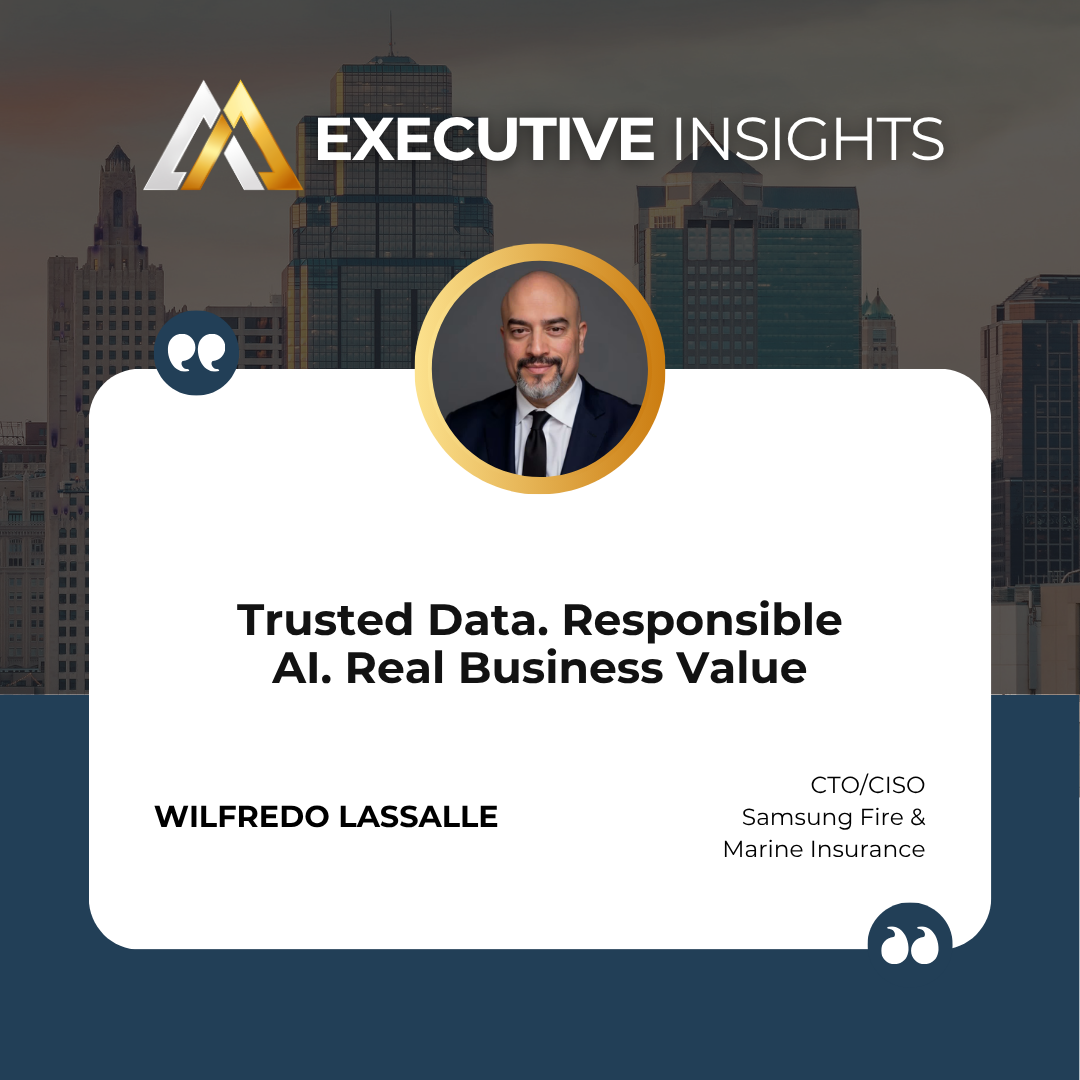
Building Responsible AI Governance with Wilfredo Lassalle
Building Responsible AI Governance with Wilfredo Lassalle
By Wilfredo Lassalle, CTO/CISO, Samsung Fire & Marine Insurance
- What are your top data priorities: business growth, data security/privacy, legal/regulatory concerns, expense reduction?
My top data priority is making data usable, trusted, and protected at the same time. I do not see business growth, security, privacy, regulatory compliance, and cost discipline as separate priorities. In a mature organization, they have to work together.
For me, the order starts with data governance and data security because AI cannot scale safely on top of poorly understood data. If we do not know where the data lives, who owns it, who can access it, how it is classified, and whether it is accurate, then every AI initiative inherits that weakness.
After that, the focus becomes business enablement. Good data should help the business move faster, make better decisions, reduce friction, and serve customers more effectively. The goal is not to lock data away. The goal is to create a secure, governed data foundation that the business can confidently use.
- What is the current state of Big Data and AI investment, and do you sense the pace changing?
The pace is absolutely changing. We have moved from AI curiosity to AI budget reality. A few years ago, many organizations were experimenting with pilots, proofs of concept, and isolated productivity tools. Now the conversation is shifting to enterprise adoption, cost management, measurable ROI, data readiness, and governance.
I think investment will continue to grow, but it will become more disciplined. Boards and executive teams are no longer impressed by a clever demo. They want to know what business problem AI solves, what risk it introduces, what data it touches, how much it costs to run, and whether the organization can scale it responsibly.
The next phase of AI investment will be less about buying tools and more about building capability: data platforms, integration, security controls, governance models, workforce training, and operating discipline.
- What are the biggest challenges your company has faced when implementing AI technologies, and how did you overcome them?
The biggest challenge is not the model. The biggest challenge is organizational readiness. AI exposes weaknesses that already exist: fragmented data, unclear ownership, inconsistent processes, immature governance, and uneven comfort levels across the business.
Another challenge is balancing innovation with control. You want the organization to experiment and learn, but you cannot allow sensitive data, regulated data, or customer information to be used without clear guardrails.
The way to overcome that is to create a practical governance model. That means defining approved use cases, acceptable data usage, human review expectations, vendor requirements, logging, monitoring, and escalation paths. It also means educating employees. People need to understand not only what AI can do, but where it can be wrong, risky, or inappropriate.
- How does your organization address ethical concerns surrounding AI, such as bias, transparency, and accountability?
Ethical AI starts with accountability. Someone has to own the use case, the data, the risk, and the outcome. AI cannot become a place where responsibility disappears.
We address ethical concerns by focusing on practical controls: understanding the data being used, reviewing outputs for accuracy and bias, maintaining human oversight, documenting approved use cases, and being transparent when AI is involved in meaningful decisions or customer-facing interactions.
I also believe AI governance has to be risk-based. A low-risk internal summarization tool does not need the same governance as an AI system influencing a customer outcome, employment decision, financial decision, or regulated process. The higher the potential impact, the stronger the controls need to be.
- How has AI influenced decision-making processes, and what challenges have arisen in balancing human judgment with AI recommendations?
AI is improving decision-making by helping people process more information faster. It can summarize large amounts of data, surface patterns, identify anomalies, and give leaders a better starting point for analysis.
The challenge is that AI can sound confident even when it is wrong. That creates a risk of overreliance. People may accept a recommendation because it came from a system instead of challenging the assumptions behind it.
My view is that AI should improve human judgment, not replace it. For important decisions, AI should be treated as an input, not the final authority. Leaders still need to ask hard questions, understand context, consider risk, and own the outcome.
- Many companies struggle to scale AI beyond pilots. How has your organization succeeded, or how does it plan to succeed, in scaling AI across departments or regions?
Scaling AI requires moving from experimentation to an operating model. Pilots are useful because they help the organization learn, but pilots alone do not transform a business.
To scale, you need a clear intake process, approved use-case categories, data governance, security review, vendor standards, architecture patterns, training, and measurable outcomes. You also need executive sponsorship and business ownership. AI cannot be something technology pushes into the business. The business has to own the problem and the value.
The other key is reuse. If every department builds AI differently, you create fragmentation and risk. Scaling requires common platforms, shared controls, reusable patterns, and a governance model that enables speed without losing control.
LinkedIn: www.linkedin.com/in/wlassalle/
SHARE THIS ARTICLE


