


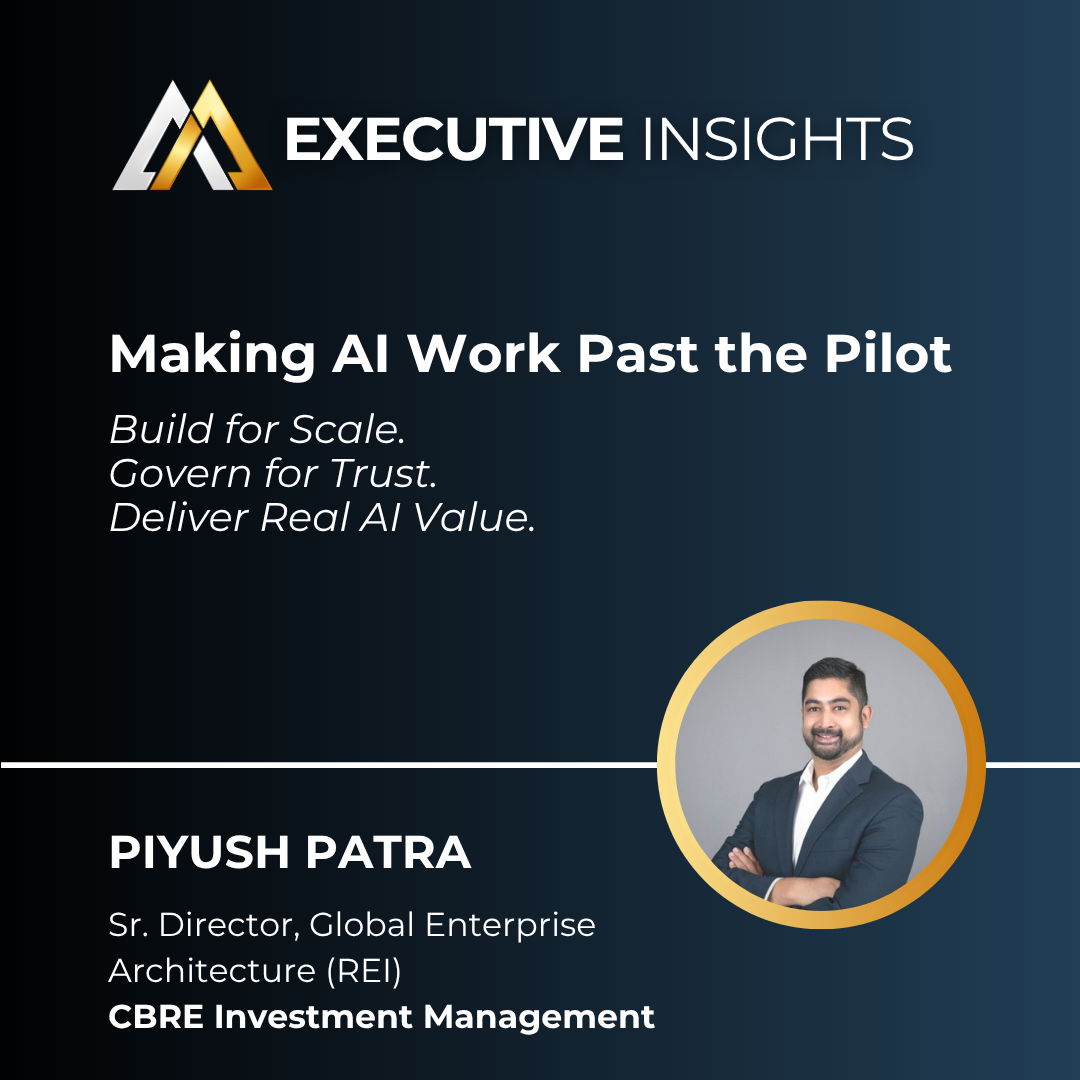
Making AI Work Past the Pilot with Piyush Patra
Making AI Work Past the Pilot with Piyush Patra
An Apex 1:1 with Piyush Patra, Digital & Technology Sr. Director, CBRE Real Estate Investments
Apex chats with Piyush Patra, who leads enterprise architecture for the Real Estate Investments (REI) business segment at the world’s largest commercial real estate services and investment firm, CBRE.
Piyush has more than 15 years of experience designing cloud, data and AI platforms in regulated industries, from health insurance and banking to real estate investment. Before CBRE, he led solutions architecture for analytics and AI across the Amazon Web Services (AWS) global systems integrator partner network and was a founding member of Microsoft’s Remote Delivery Center for the Americas. Following the CIO and CTO panel at Apex’s West Transformation Assembly, Piyush shares why so many AI programs get stuck between demo and production—and how thoughtful architecture can help move them forward.
Views described here are personal views of the interviewee and not CBRE.
What is your role, and how does enterprise architecture help move AI into production?
I lead enterprise architecture for CBRE’s Real Estate Investments business, which includes CBRE Investment Management and Trammell Crow Company, the largest real estate developer in the US. I own the segment’s technology map—its applications, data, integrations, suppliers, future direction, and decisions to get there.
In practice, my role centers on three priorities. I serve as the design authority, reviewing solutions before investment, documenting our decisions and the rationale behind them, and maintaining a curated list of approved products and patterns to ensure teams avoid duplicating efforts. I engage early in the most critical programs, ideally before supplier selection begins. I also bridge disciplines. Investment professionals focus on deals, funds, and returns. Engineers prioritize APIs and latency. My value lies in connecting these perspectives, ensuring that strategic and technical conversations align to drive meaningful outcomes.
The rules of architecture are evolving alongside the CIO and CTO roles. Where once the focus was on mapping out a future state, today’s mandate is to ensure that every new AI solution integrates seamlessly with the data, controls, and platforms that power our organizations. This shift demands not just technical expertise, but a strategic vision for how technology can drive meaningful progress.
How do you evaluate and integrate emerging technologies like artificial intelligence, machine learning, or the Internet of Things (IoT) into your IT strategy, and what factors do you consider when determining their potential impact on the organization?
I start with the business problem, then pick the least complicated technology that solves it. The market pushes the other way. Gartner expects more than 40% of agentic AI projects to be canceled by the end of 2027 because of rising costs, unclear business value or weak risk controls. It also estimates that only about 130 of the thousands of suppliers selling “agentic” products offer the real thing [1].
I use a simple ladder. Fixed steps and known rules call for automation. Fixed steps with one judgment call, such as abstracting a lease, call for an AI-assisted workflow. Only when the path itself changes with the situation do I consider an autonomous agent. Moving up each rung adds cost, testing effort, and risk.
Then I look at five things: business value someone will put their name to, fit with our data and identity platforms, security exposure, the full cost to run it, and the cost of leaving if the supplier or model changes. That last one gets underestimated. Models change every few months. Your architecture shouldn’t have to.
Many companies struggle to scale AI solutions beyond pilot projects. How has your organization succeeded (or plans to succeed) in scaling AI across departments or regions?
Real estate has a wider gap than most. In Deloitte’s 2027 Commercial Real Estate Outlook, 92% of executives surveyed said their firms are still researching or piloting AI, and only 8% have integrated it [2].
Across industries, the numbers look better, but returns lag. In McKinsey’s 2026 State of AI survey, 44% of respondents said AI is scaling across their enterprise, yet the share attributing any earnings before interest and taxes (EBIT) impact to AI held flat at 37% [3].
Pilots stall for three reasons: no business owner is accountable for the outcome, a one-time data extract cannot sustain production, and security and legal are brought in too late. Without ownership, a live data foundation and early involvement from critical partners, the pilot loses momentum before it can deliver lasting value.
I sort AI work into three layers: AI in the flow of work, such as everyday assistants; AI inside business processes, where a workflow is redesigned around it; and AI as a strategic capability that changes how the business competes. Each layer needs different funding, ownership and controls.
Then comes reuse. The first use case should pay for the platform, the patterns and the guardrails. By the tenth, most of the work should be configuration.
How do you make AI safe to scale without slowing innovation?
I learned data discipline long before generative AI. In regulated reporting, I led the team that built and ran encounter data submissions to the Centers for Medicare & Medicaid Services. When a federal agency rejects your file, nobody cares how good the dashboard looks.
Three practices matter most. Put ownership with the domain that creates the data. My experience with data mesh reinforced that principle, and it matters even more for AI, because the domain expert is the one who can tell you an answer is wrong. Classify data before a use case is approved, and make that classification follow the data into prompts, search indexes and agent tool calls. And give AI the same front door as everyone else: the same governed APIs, identity checks and logging a person would go through. No side doors for the sake of a demo.
What strategies do you employ to balance innovation with risk management when designing complex IT systems, and how do you ensure alignment between the architectural vision and the business goals of the organization?
I try to make the safe path the fast path. If the governed route takes six weeks and the workaround takes six days, people take the workaround, and you find out later.
For AI, that means tiering by risk. An assistant that summarizes public market research shouldn’t face the same review as an agent that can write to a system of record. The National Institute of Standards and Technology (NIST) AI Risk Management Framework and its Generative AI Profile give teams a shared language for those tiers [4]. For agents, the most practical guide I’ve found is the Open Worldwide Application Security Project (OWASP) Top 10 for Agentic Applications. It covers risks such as goal hijacking, tool misuse and failures that cascade across agents [5].
The controls aren’t exotic. Register every agent and every tool connection, and give each one its own identity, least-privilege access, logging, versioning and a tested rollback. Deloitte found that fewer than half of the real estate firms it surveyed have stronger controls, such as challenger models, exception handling or detective controls in place [2]. I’d close that gap before adding the next use case.
On alignment, I push to be involved before a program is funded. Once the supplier is selected, a design review turns into a negotiation. And I’d judge an architecture team on business results, such as cost avoided through reuse. The number of reviews it ran tells you very little.
Which AI developments could make the biggest practical difference in real estate investment management?
There are two connected trends.
The first is a standard way for AI agents to connect to data and tools. The Model Context Protocol (MCP) offers a common standard for those connections. Integration has always been where AI projects get slow and expensive. A common protocol helps us govern agent connections the way we govern APIs, with a registry, a gateway and clear ownership. It also opens a new attack surface, so governance has to keep up.
The second is what this means for real estate operations. Morgan Stanley Research estimated that 37% of tasks at the 162 real estate investment trusts (REITs) and commercial real estate firms it studied could be automated, worth about $34 billion in efficiencies by 2030 [6]. In investment management, the best early candidates are unglamorous: pulling terms from leases and offering memorandums, drafting first-pass investment memos, reconciling investor reports. They eat analyst hours and follow patterns that a well-governed agent can handle, with a person signing off.
What should architects learn—and do differently—to make AI work beyond the pilot?
You can’t hire your way out of every skills gap. You have to grow your people.
I previously built and led an enablement path for the AWS Certified AI Practitioner exam for more than 200 architecture and delivery professionals. My takeaway: the certificate is the floor. People learn when they apply it to a real problem from their own backlog within weeks. Otherwise, it fades.
For architects, I push three skills. Evaluation: testing whether an AI system is right often enough for the job, and what happens when it’s wrong. Cost: tokens, retrieval and hosting add up, and one in five McKinsey respondents say AI operating costs already limit their AI use [3]. And domain fluency. An architect who understands how a fund reports to its investors will design a better system than one who knows every framework but not the business.
Human skills matter just as much, especially analytical thinking.
What lessons or advice have helped you get to where you are today?
Spend time on the business side. I learned this by taking a role with direct responsibility for business outcomes. Owning a regulatory deadline, instead of advising on one, changed how I think about systems.
Write your decisions down. A decision with no record gets reopened every six months. A one-page note on what we chose, what we rejected and why has saved me more time than any tool.
Stay close to the technology. I keep my certifications current and still build small prototypes. You can’t judge a supplier’s claims or a team’s estimate if you’ve lost touch with how the technology behaves.
And earn trust before you need it. Most of what I do depends on people choosing to bring me in early. They only do that if it helped the last time.
“Models change every few months. Your architecture shouldn’t have to.”
About Piyush Patra

Piyush Patra is Sr. Director, Global Enterprise Architecture for CBRE’s Real Estate Investments business. He has more than 15 years of experience across enterprise, cloud, data and AI architecture in financial services, insurance, healthcare and real estate. Before CBRE, he led solutions architecture for analytics and AI with AWS’s global systems integrator partners, was a founding member of Microsoft’s Remote Delivery Center for the Americas, and worked as a technical architect consultant to JPMorgan Chase. He has published whitepapers and AWS blog posts on data mesh, cloud data migration and generative AI, and holds multiple AWS and Microsoft Azure certifications.
LinkedIn: https://www.linkedin.com/in/piyush-patra-54532817/
Sources
[1] Gartner. “Gartner Predicts Over 40% of Agentic AI Projects Will Be Canceled by End of 2027.” Press release, June 25, 2025.
https://www.gartner.com/en/newsroom/press-releases/2025-06-25-gartner-predicts-over-40-percent-of-agentic-ai-projects-will-be-canceled-by-end-of-2027
[2] Deloitte Center for Financial Services (Kathy Feucht, Sally Ann Flood, Tim Coy). “2027 Commercial Real Estate Outlook.” Deloitte Insights, September 24, 2026.
https://www.deloitte.com/us/en/insights/industry/financial-services/financial-services-industry-outlooks/commercial-real-estate-outlook.html
[3] McKinsey & Company (Dan Tinkoff, Lieven Van der Veken, Michael Chui, Tara Balakrishnan). “The state of AI in 2026: On the road to ROI.” August 25, 2026.
https://www.mckinsey.com/capabilities/quantumblack/our-insights/the-state-of-ai
[4] National Institute of Standards and Technology. “AI Risk Management Framework” (AI RMF 1.0, January 26, 2023) and “NIST AI 600-1: Generative Artificial Intelligence Profile” (July 26, 2024).
https://www.nist.gov/itl/ai-risk-management-framework
https://doi.org/10.6028/NIST.AI.600-1
[5] OWASP GenAI Security Project. “OWASP Top 10 for Agentic Applications for 2026.” December 9, 2025.
https://genai.owasp.org/resource/owasp-top-10-for-agentic-applications-for-2026/
[6] Morgan Stanley Research. “How AI Is Reshaping Real Estate.” July 2, 2025.
https://www.morganstanley.com/insights/articles/ai-in-real-estate-2025
SHARE THIS ARTICLE


