


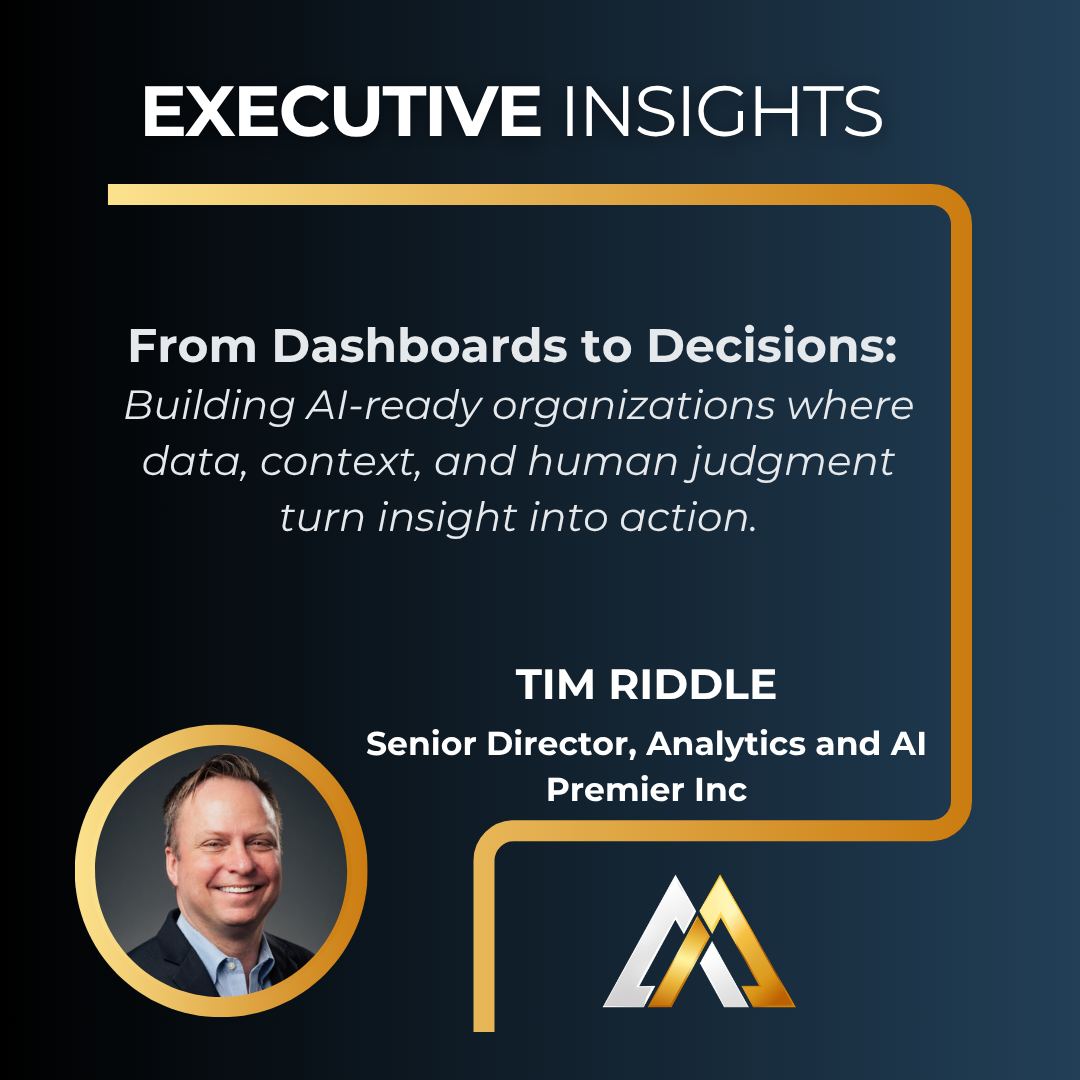
Building AI-Ready Organizations: Tim Riddle
From Dashboards to Decisions: Building AI-Ready Organizations Where Data, Context, and Human Judgment Turn Insight Into Action
Artificial intelligence is reshaping how organizations make decisions, but the fundamentals haven’t changed: teamwork, governed data, clear context, and disciplined execution. Leading analytics and AI initiatives in healthcare has taught me that when those fundamentals are strong, organizations can move from static dashboards to intelligent, conversational systems that accelerate insight. Clinical, operational, or financial—the domain does not matter. The real differentiator is leadership: people, process, and technology aligned around a shared mission. In this Executive Insight, I share practical lessons from building AI-ready environments that apply to any industry navigating the shift toward modern, context-aware decision support.
Q1 — How do you see AI transforming the business landscape in the next 5–10 years, and how are you preparing for these changes?
AI is shifting from a technology initiative to a leadership initiative. Over the next decade, organizations will move from dashboards to conversational, context-aware systems that surface insights in real time. That shift reduces cognitive load, speeds decision-making, and makes analytics accessible to every leader—not just technical teams.
Preparing for this future comes down to three fundamentals: AI-ready data; semantic clarity so meaning is not misinterpreted; and practical guardrails that build trust. When those foundations are strong, AI becomes a force multiplier instead of a risk multiplier.
Q2 — What are the biggest challenges organizations face when implementing AI technologies, and how have you approached them?
The biggest challenge in any AI environment isn’t the model—it’s meaning. AI is fast and confident, but it will confidently scale mistakes if the semantics are unclear. If the meaning is wrong, the model simply makes the mistake faster.
The next challenge is change management. The organization must be ready, prepared, and sometimes redesigned to adopt the innovation. That was true long before AI reached its current scale—and it is even more critical now.
My approach focuses on making data AI-ready and ensuring version 1 delivers real value. I emphasize cross-functional collaboration—domain experts, data teams, and platform specialists working together to build solutions that are safe, scalable, and aligned with real-world workflows.
Q3 — AI depends heavily on data. How do you ensure the quality, security, and governance of the data used in AI projects?
I treat data governance as a defensive system, not a compliance checkbox. Quality, lineage, and trust must be established before any model is deployed. If the data is not trustworthy, the AI will not be either.
My approach starts at the source—fixing data upstream, enforcing consistent pipelines, and ensuring every dataset carries the metadata and context needed for safe interpretation.
Security is built into the architecture, not bolted on. Automated lineage, access controls, and monitoring keep AI workloads inside clear boundaries. Strong controls accelerate innovation by reducing uncertainty.
Q4 — How has AI influenced decision–making processes, and what challenges arise in balancing human judgment with AI recommendations?
AI has changed the speed of decision-making, but not the responsibility for it. AI can surface insights instantly, but human judgment still matters. The challenge is ensuring that AI outputs are interpretable, contextual, and aligned with the decision-maker’s intent.
AI should augment judgment, not replace it. When leaders understand both the strengths and limitations of AI, decision-making becomes faster and safer.
Q5 — Many companies struggle to scale AI solutions beyond pilot projects. How have you approached scaling AI across teams or functions?
Scaling AI requires reusable patterns. Pilots fail when they are bespoke—handcrafted solutions that cannot be repeated. I focus on building reusable workflows and proven foundations to reduce risk and increase the likelihood of success.
The second key is portfolio discipline. Not every AI idea deserves to be built. I prioritize high-value, low-friction use cases with multiple applications. That builds momentum and trust while allowing small investments to have an outsized impact. Early wins create organizational pull for larger initiatives. Every proof of concept should also have a path-to-production plan, clear ownership, and a measurable outcome before it starts. Reaching production is not the finish line; improving a business or clinical outcome is.
Q6 — How important are partnerships with AI vendors, research institutions, or startups in your overall AI strategy?
Partnerships are essential. No organization has all the talent, context, or platform expertise required to build AI at scale. I treat partners as part of the roster—platform providers for acceleration, domain experts for context, data and security teams for safety, and startups for innovation.
AI is a team sport, and the roster determines the outcome.
Q7 — What emerging trends in AI are you most excited about, and how do you see them shaping business operations?
Natural-language analytics is the most transformative trend I have seen. When leaders can query outcomes data in plain English, the dashboard era ends—and decision-making becomes conversational, real-time, and accessible across the enterprise.
Multi-agent systems are equally exciting. They allow specialized AI agents to work together across a workflow—gathering information, checking context, recommending actions, and completing defined steps with clear limits and human oversight. It is reducing the distance between insight and action.
About the Author
Tim Riddle is a healthcare analytics and AI leader focused on building governed, context-aware data environments that support modern decision-making. His work spans enterprise data modernization, natural-language analytics, and multi-agent orchestration on contemporary platforms. He has delivered more than a dozen solutions from inception to production and has trained and mentored hundreds of AI and analytics professionals.
Tim’s leadership philosophy comes from the fundamentals he learned growing up playing basketball in Alaska—teamwork, preparation, context, and disciplined execution. He is the creator of an eight-pillar AI leadership framework and will deliver the upcoming keynote, The Dashboard Is Dead, exploring the future of decision support in healthcare and beyond.
SHARE THIS ARTICLE


