


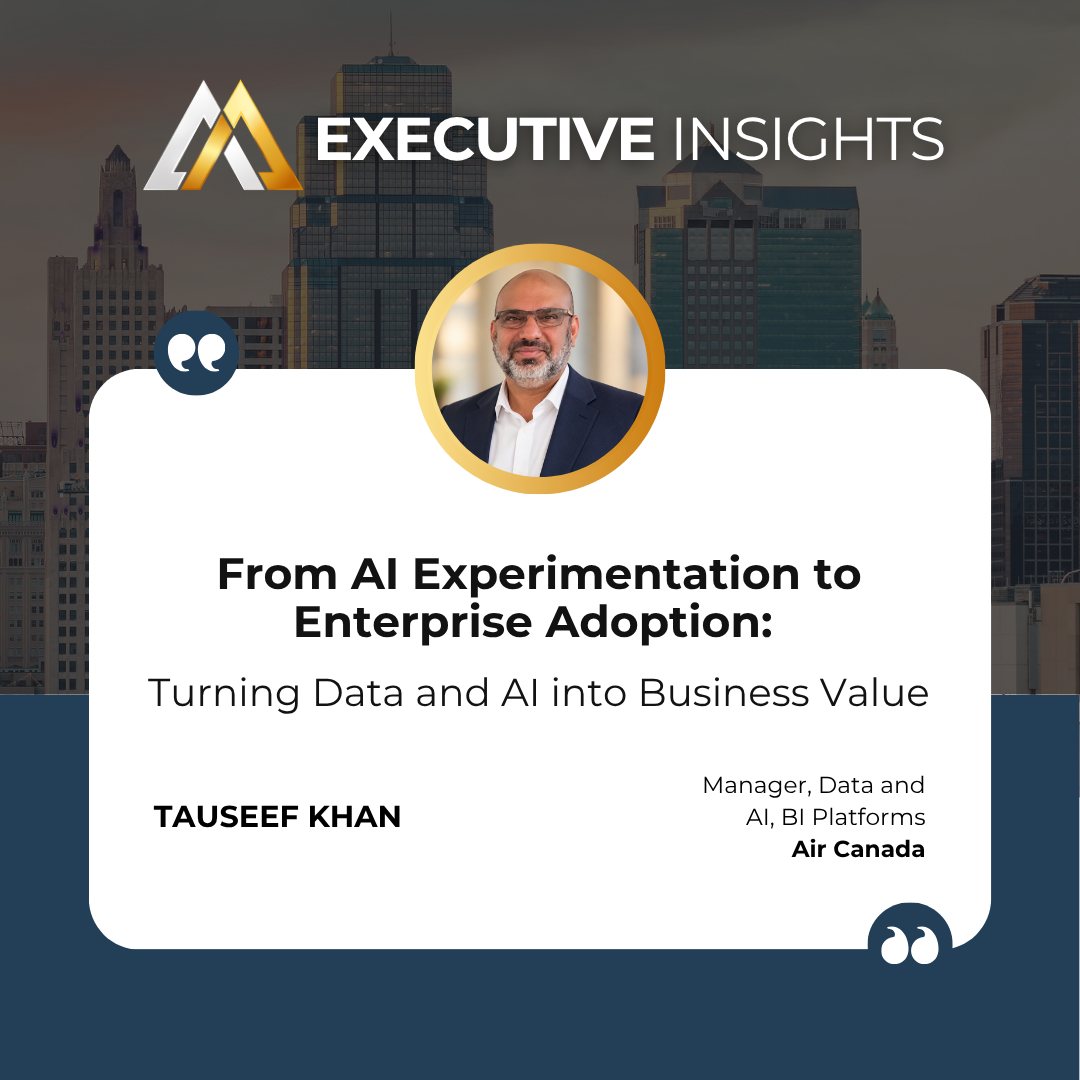
From AI Experimentation to Enterprise Adoption: Turning Data and AI into Business Value By Tauseef Khan
From AI Experimentation to Enterprise Adoption: Turning Data and AI into Business Value
1. How would you describe your role, and how has it evolved as data, analytics and AI have become more important to the enterprise?
My role sits at the intersection of data, technology and business decision-making. I lead enterprise BI platforms and capabilities, but over time the role has evolved well beyond delivering reports, dashboards or technology platforms.
A growing part of my focus is creating the environment that allows people across the organization to use data effectively—through scalable platforms, governance, common standards, communities of practice and stronger partnership with the business.
AI is accelerating that evolution. As analytics becomes increasingly augmented by AI, data leaders have to think beyond technology. We need to think about adoption, trust, accountability and measurable business outcomes.
For me, the real objective has always been the same: helping people move from having more data to making better decisions and that is the main topic of my upcoming book Modern BI in the Enterprise: From Data to Decisions
2. Many organizations are experimenting with AI, but relatively few are successfully scaling it across the enterprise. What separates experimentation from sustainable enterprise adoption?
I think one of the biggest differences is that experimentation is largely a technology challenge, while enterprise adoption is an organizational challenge.
Today, it is relatively easy to demonstrate an impressive AI use case. The difficult questions come afterward: Who owns it? How does it fit into an existing business process? Can people trust the underlying data? How will success be measured? What governance is required? and will people actually use it?
I have seen a similar pattern throughout the evolution of enterprise analytics. Technology can be deployed relatively quickly, but sustainable adoption requires clear ownership, governance, prioritization and engagement with the people who will ultimately use the capability.
AI will be no different. The organizations that succeed won’t necessarily be those running the most experiments but the one that become good at turning successful experiments into repeatable enterprise capabilities.
3. AI depends heavily on data. How important are data quality, governance and trusted business definitions to successful AI adoption?
They are foundational.
For years, organizations could sometimes work around data-quality issues because an experienced analyst understood the context and could recognize when something didn’t look right. As AI becomes more deeply embedded in analysis and decision-making, those weaknesses become much more consequential.
AI doesn’t reduce the need for governance. In many ways, it increases it.
Organizations need confidence in where their data came from, what it means, who owns it and whether important business definitions are consistent. If different parts of an organization interpret the same metric differently, putting AI on top of that inconsistency doesn’t solve the problem.
This is why I don’t see BI, data governance and AI as separate conversations. They are increasingly part of the same journey. Trusted AI starts with trusted data.
4. How should organizations balance AI-driven recommendations with human judgment and accountability?
I believe the objective should be decision enablement, not simply decision automation.
AI can process enormous amounts of information, identify patterns and surface recommendations at a speed and scale that humans cannot. But many important business decisions also involve context, experience, competing priorities and consequences that aren’t always fully represented in the data.
Organizations therefore need to be deliberate about where AI assists a decision, where automation makes sense, and where human judgment should remain central.
Accountability is equally important. If an AI system recommends an action, someone still needs to understand the context and own the resulting business decision.
For me, the real opportunity isn’t removing people from decision-making. It’s giving them better information, earlier signals and stronger analytical capabilities so they can make better decisions.
5. Technology is only one part of transformation. What role do operating models, business ownership and cross-functional collaboration play in successful AI adoption?
A critical one.
One of the strongest lessons I’ve learned from large-scale analytics transformation is that technology can enable change, but it rarely creates sustainable change by itself.
Central data and technology teams can provide platforms, standards, governance and expertise. But the people closest to the business understand the decisions, processes and operational realities where value ultimately has to be created.
At the same time, completely decentralized approaches can lead to duplication, inconsistent definitions and fragmented solutions. That’s why I believe strongly in a federated operating model: strong enterprise foundations combined with meaningful ownership within business domains.
I’ve seen communities of practice and cross-functional governance become particularly valuable in this kind of environment. They create a mechanism for sharing knowledge and standards without taking ownership away from the business.
The same principle applies to AI. AI shouldn’t simply be something a central technology team delivers to the business. The business needs to help define the problem, shape the solution, measure the outcome and own the resulting change.
6. How do you prepare teams for a world in which AI increasingly becomes part of everyday work without losing the importance of human expertise?
I think leaders need to frame AI as something that changes how work gets done, rather than simply as technology that replaces work.
Some activities will certainly become automated. At the same time, other capabilities become more valuable—critical thinking, business understanding, communication, curiosity and the ability to challenge and evaluate AI-generated outputs.
That changes the skills conversation. Technical training remains important, but people also need to understand where AI performs well, where it can fail and when human judgment is required.
I’ve also found that adoption is stronger when people are given opportunities to experiment, learn from one another and share what works. Communities and peer learning can be just as important as formal training.
Ultimately, successful AI adoption is as much about building confidence and capability in people as it is about deploying the technology.
7. Looking ahead three to five years, how do you expect AI to change enterprise decision making and the role of data and analytics leaders?
I think the boundaries between BI, analytics and AI will increasingly become less visible to the business user.
People won’t necessarily think, “I’m using a dashboard,” “I’m using analytics,” or “I’m using AI.” They will simply expect to ask a business question, understand what is happening, explore why it is happening, anticipate what might happen next and get help determining what action to take.
That’s a significant evolution from traditional reporting toward continuous decision support.
For data and analytics leaders, that expands our responsibility. Building platforms and delivering insights will remain important, but we will increasingly need to think about how information flows into decisions, how AI-generated insights are governed, how outcomes are measured and where human accountability sits.
Ultimately, I don’t think success will be measured by how much AI an organization deploys. It will be measured by whether AI helps the organization make better decisions and create measurable business value.

About the Author
Tauseef Khan is a Data & AI leader with more than 20 years of experience in business intelligence, analytics and enterprise data transformation across aviation, healthcare, life sciences and renewable energy. He currently leads enterprise BI platforms and capabilities within the aviation industry, with a focus on modern analytics, governance, AI adoption and decision enablement. Tauseef is also an author, speaker and moderator on Modern BI, enterprise AI and data-driven decision-making.
SHARE THIS ARTICLE


